

Private legal intelligence, auditable and bound to its sources.
Phoenix Legal turns an authorized case file into a matter intelligence system: evidence graph, official law corpus with version history, argument tree, contradiction detection and an audit trail that lets anyone question how each output was produced. It is not an “AI lawyer”. The lawyer decides.
For whom
Criminal defence and litigation firms, in-house legal teams, prosecutors and institutions that work with long files, heterogeneous evidence, complex timelines and a high cost of omission.
The problem
Critical information lives in PDFs, videos, messages and notes. Rebuilding time, relationships, contradictions and provenance eats hours — and the reasoning cannot be audited afterwards.
The difference
Privacy by design, private deployment, evidence-linked findings, mandatory human review and an audit trail. Unsupported claims fail closed: “not enough evidence” beats a plausible sentence.
From case file to auditable matter intelligence.
Authorized intake
Documents, media and notes enter a dedicated tenant. Every file keeps its origin, hash and permissions.
GATE: DATA READINESSMatter graph
GraphOS links people, places, evidence, events and claims. Time is reconstructed as a timeline, not a summary.
GRAPHOSOfficial corpus
Constitution, National Code of Criminal Procedure, Federal Criminal Code, Amparo Law and LFPDPPP indexed by article, with the version in force at the date of the facts. Where reliable history is missing, it says so.
1,518 ARTICLES · VERSIONEDArguments & contradictions
Argument tree with claims, counter-claims and gaps. Each node must trace to (document, page, paragraph) or (video, timestamp). Adversarial passes look for what breaks the theory.
FAIL CLOSEDReview & audit
States Proposed → Verified → Approved are set by people. An append-only log records who saw what, when, and why an output changed state.
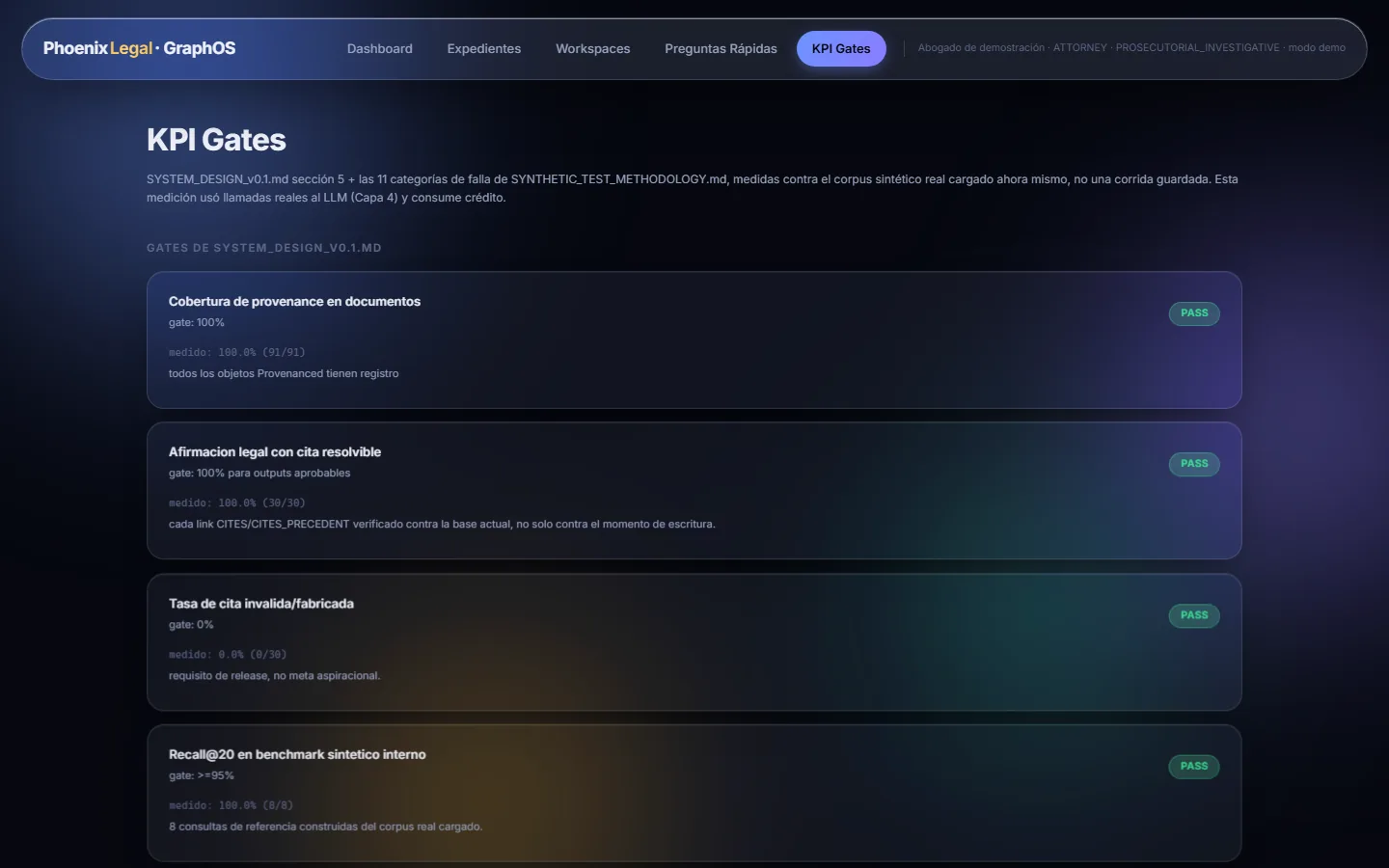
HUMAN DECISIONThe system, as it runs.
Captures are generated from the live deployment on a synthetic matter. No client data appears on this site.
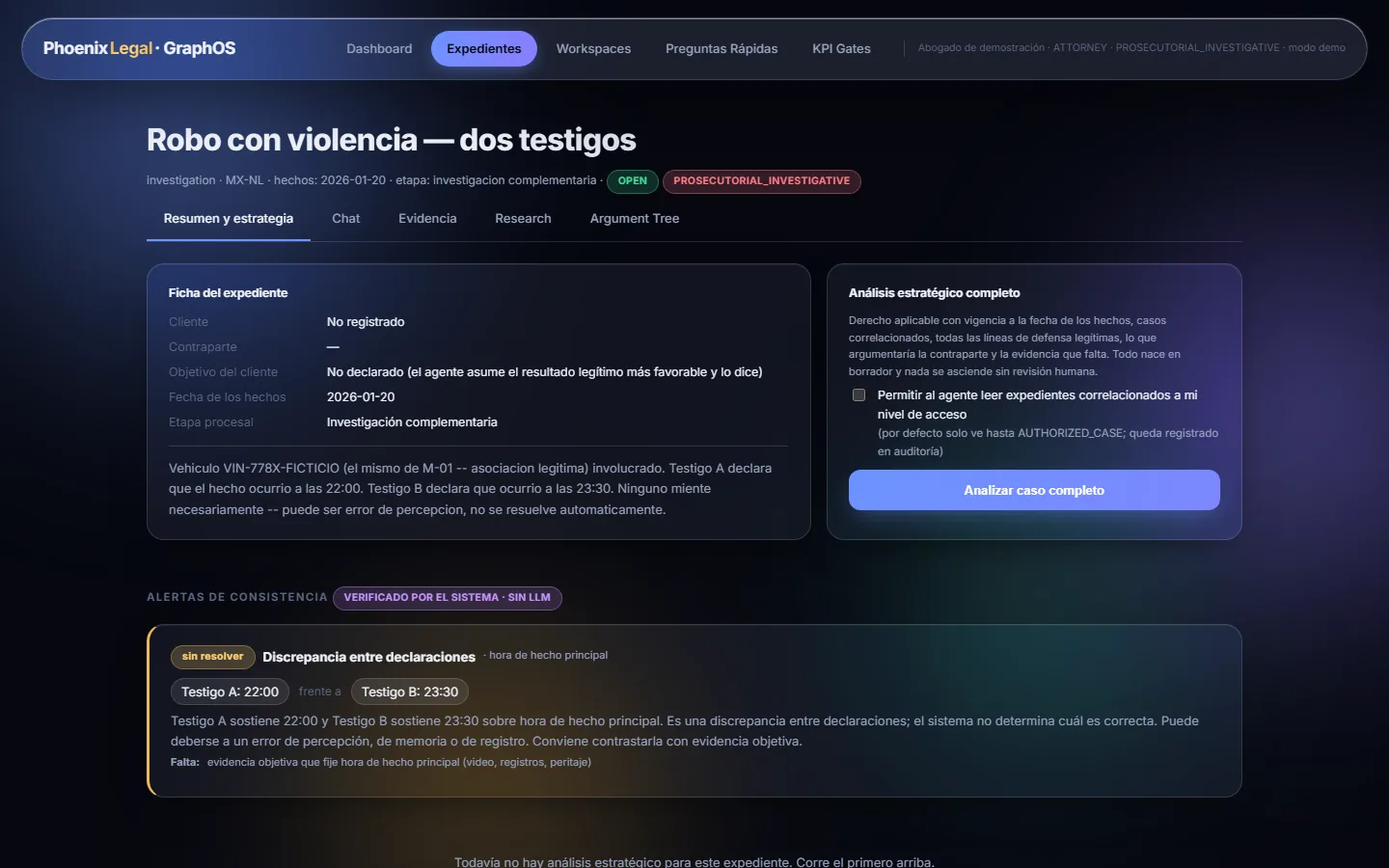
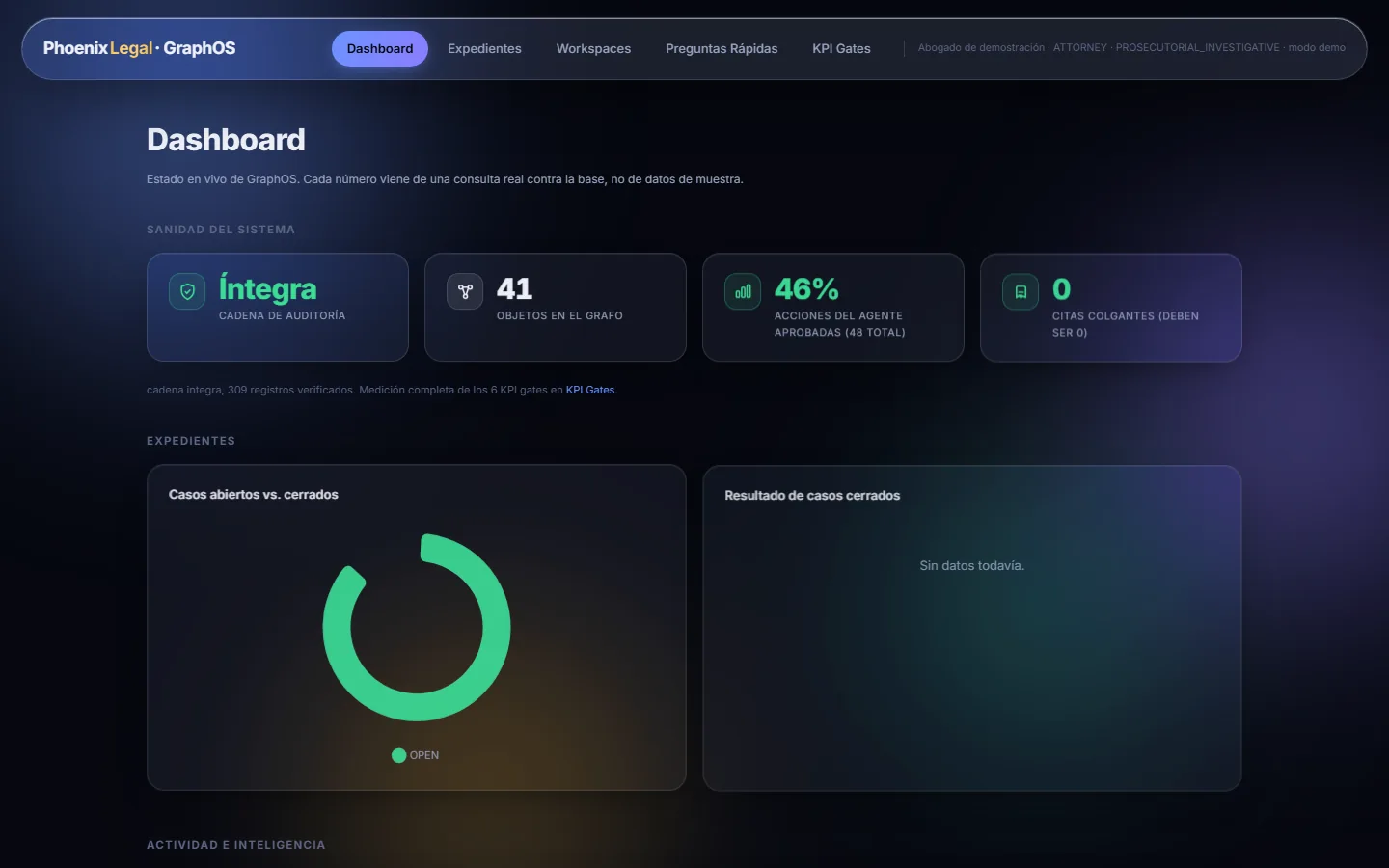
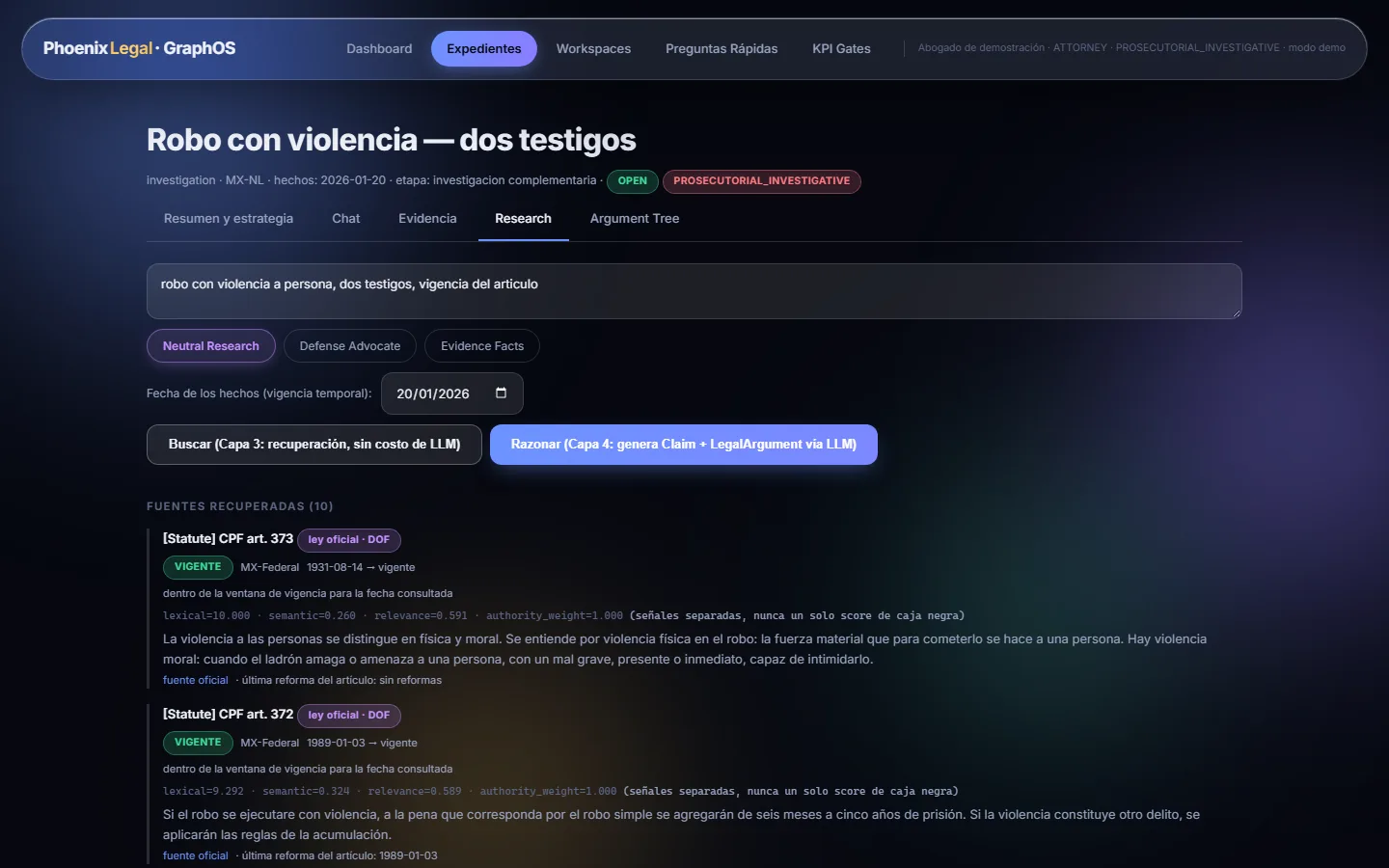
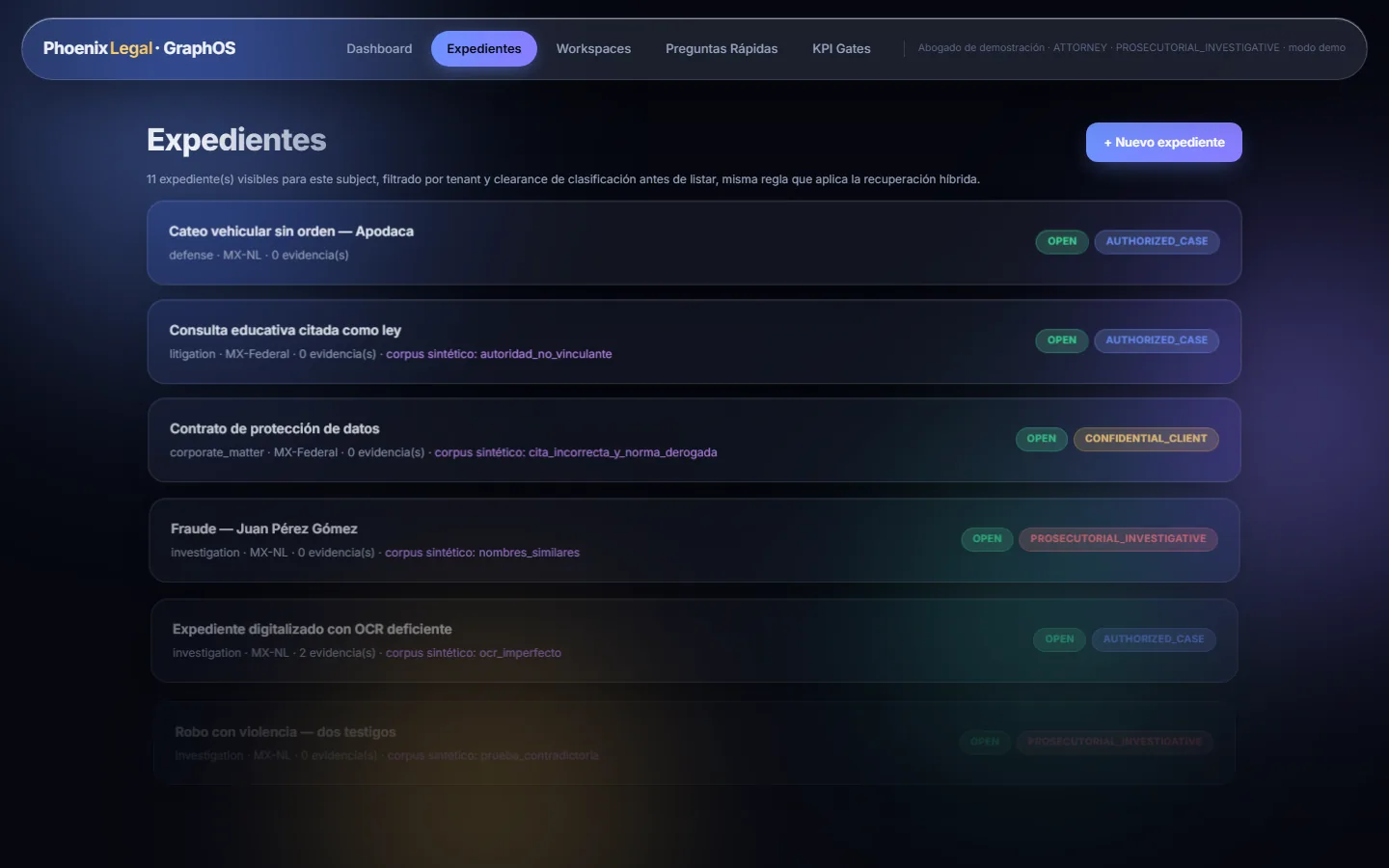
What it does. What it refuses to do.
Organizes and audits complex legal information
Retrieval with citations, timeline reconstruction, contradiction and gap detection, argument mapping.
Keeps the lawyer inside the decision loop
Every consequential output is a proposal until a responsible person verifies and approves it.
Does not give legal advice or predict rulings
No “wins cases”, no “predicts outcomes”, no autonomous decisions. Text that tries to give the system orders is treated as evidence, flagged, and never executed.
Does not train on your data
Institutional data is never used to train external models. Where required, inference runs on hardware inside the client’s perimeter.
Staged. Every stage has an exit criterion.
Controlled demo
A guided walk-through of a full flow — file, investigation, arguments, audit — on synthetic or authorized data. Access is granted by Carlos after a call; there is no self-serve signup.
EXIT: CONFIRMED INTEREST + DEFINED USE CASEDiscovery Pilot · 8 weeks
One closed, synthetic or expressly authorized matter (500–5,000 documents), 3–8 users, benchmarks: time to locate evidence, timeline accuracy, source coverage, validated findings.
EXIT: ≥2 REPEATABLE WORKFLOWS · 0 CRITICAL FINDINGS WITHOUT SOURCEDeployment
Private practice (5–10 users), enterprise (up to 25 users, integrations, governance) or sovereign institutional (isolated deployment, security controls, SLA). Implementation, licence, hardware and support are separate lines.
EXIT: CONTRACT, SCOPE AND RESPONSIBILITIES APPROVEDNo hardware purchase required. One authorized or synthetic matter, 3–8 users, benchmarks and exit criteria defined before the start.
Users, matters, integrations, retention, availability and isolation level drive the price. Hardware for local inference is a separate line with a 15–25% integration margin and is built when a client requires it.
Pilots are paid: they cover learning and delivery. They are not a free trial and not a disguised production run.
Request a controlled demo.
Access to the system is granted by Carlos after a call. Tell us the type of matter, the users and what a successful pilot would prove.